Polkadot Blockchain Academy Hosts Events for Regional Leaders
By: Mauro Berchi
The National Technological University (UTN), the University of Buenos Aires (UBA), the government of Santiago del Estero and more than 100 leading technology innovation companies in Latin America held various gatherings with the most prominent blockchain experts.
At the events, Polkadot Blockchain Academy (PBA) welcomed in total more than a thousand young technology enthusiasts, who had the opportunity to hear how the blockchain software architecture founded by Gavin Wood has been renewed and allows the most varied developments, from a sports fan application to stablecoin wallets, to function with greater security and interoperability without sacrificing robustness.
The Future Is Web3
PBA co-founder Marina Marchesotti stated in Buenos Aires that “we all know that today, many times, we are using blockchain without realising it,” in an address regarding the mission of this non-profit organisation. “As Dr. Gavin Wood points out, education about the fact that the decentralisation of technology offers possibilities that many people are still unaware of is fundamental,” she explained.
In that regard, the conferences delivered in the province of Santiago del Estero, Argentina, were key. The opening, on the afternoon of last Wednesday, was directed at 400 secondary school students and delivered by Primavera De Filippi, a French lawyer with an academic background and researcher at Harvard, whose presentation centred on governance in an internet “that will no longer be in the hands of a few companies.”
Gavin Wood, author of the Ethereum code, the most widely used blockchain in the world, on which more than USD 11 million is transacted per day, creator of the Web3 concept and founder of Polkadot, explained to authorities and entrepreneurs from different parts of the world what the future of technology management will look like, well beyond cryptocurrencies.
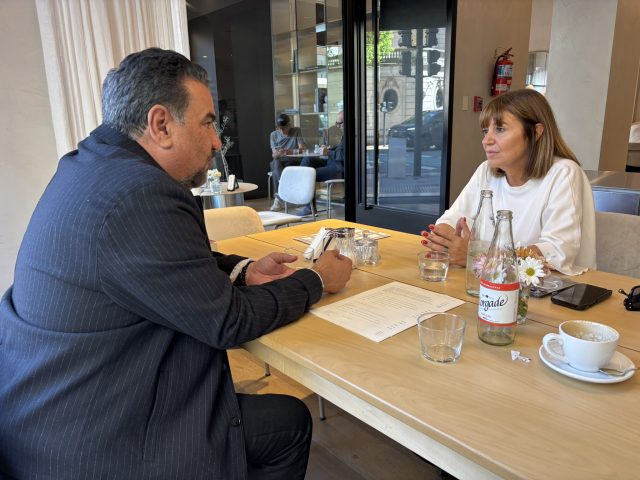
Dominican architect Rodolfo Pou and PBA co-founder Marina Marchesotti.
“In the 80s and 90s, to send money from one side of the ocean to the other, we used financial and banking networks because there was no other technology, but now there is. In other words, it is no longer necessary to place trust in institutions that concentrate power, because cryptography allows us to have certainty about the information that represents our money or any other asset,” he highlighted.
His address was, in general terms, philosophical, as it posed dilemmas that society faces every day “when we revalidate the social contract through the terms and conditions we accept without reading, in order to use the digital tools that connect us to the world, but which retain our data and hold too much power.”
Dominican Republic Attends the Event
In that context, Dominican architect Rodolfo Pou, director of the think tank Diaspora and Development Foundation, based in the United States, participated in the first leg of this tour in Buenos Aires. “It has been a more than enriching experience, not only for the level of the speakers and the entire organisation, but also because I found receptiveness for the project we are driving from the diaspora,” Pou affirmed in the Assembly Hall of the UBA Faculty of Law.
Pou expressed satisfaction with the encounter with Gavin Wood, and highlighted the private meeting he held with Marchesotti in which they analysed alternatives for his project.
“Since 2022 we have been working with my team on the possibility of the Dominican Republic being able to finance its growth and development using a sovereign token whose value arises from the commitment of our diaspora. Those of us who emigrated want to be protagonists in the present and future of our country, well beyond the sending of remittances, although the latter will also be possible through the use of the same instrument. In that regard, having studied cases such as that of Indonesia, we believe Polkadot is the ideal platform,” Pou explained.
The Moment of Latin America
Pou’s words are in complete alignment with the global perspective proposed by PBA. Indeed, Marchesotti highlighted that the region finds itself at a key moment, because “blockchain is being used more and more, and given the conditions of the global economy, plus the undeniable talent of our young people, it is clear that the Web3 paradigm, that is, a decentralised, open internet that gives us freedom, will play an ever greater role.”
The itinerant nature of this model has allowed Polkadot to sign agreements recently with the governments of Indonesia and Hong Kong.
In that regard, Pou affirmed that “we are already working to welcome these true leaders of technological change in the Dominican Republic very soon. Blockchain is the right technology to build the bridge between the diaspora and their compatriots in the country of origin, especially when it comes to nations that have overseas representatives, such as the Dominican Republic. We are always thinking about returning, and the best thing is to contribute to the development of that people whose collective dream shelters us in our homeland and abroad,” he expressed.
The event organised by PBA was conceived with elements drawn from the entertainment production industry, the field in which Marchesotti trained. To this is added the solid track record in educational innovation of Pauline Cohen Vorms, one of the founders of Coursera, the successful online learning platform.
The experiences, meanwhile, create situations of encounter between community members, with complete openness to diversity.